Lord Ganesha is one of the most beloved deities in Hinduism worshipped as the remover of obstacles, the lord of beginnings, and the embodiment of wisdom. While his elephant head, pot belly, and iconic attributes attract much attention, one symbol remains especially intriguing: his vehicle (vahana), the humble rat.
At first glance, the pairing appears unusual. Why would a large, powerful deity choose a tiny creature often seen as destructive or insignificant as his mount? The answer is surprisingly profound. Ganesha’s rat (known as Mushika or Mooshak) holds deep spiritual, philosophical, and symbolic meaning. Understanding this symbolism helps us appreciate the rich layers of Hindu iconography and the universal life lessons hidden within.
This guide explores why the rat is Ganesha’s vahana, what it represents, and how its symbolism can be applied in modern life.
1. The Rat and Its Symbolic Significance in Hindu Thought
Rats are creatures known for their speed, adaptability, and survival instincts. They thrive in darkness, squeeze through tiny spaces, and can overcome complex barriers to reach their goal food. These traits form the foundation of the symbolism in Hindu philosophy.
The Rat Represents Human Desires
Desires whether material, emotional, or mental share qualities with rats:
- They grow quickly
- They can be unstoppable
- They enter unnoticed
- They hide in corners of the mind
- They become destructive when uncontrolled
In the spiritual sense, desires create inner obstacles, keeping individuals tied to habits, attachments, fears, and temptations.
Ganesha riding the rat symbolizes mastery over these desires, rather than their suppression. It teaches that desires can be redirected toward meaningful purpose when disciplined.
2. Ganesha Riding the Rat: Power over Ego and Impulse
The rat represents not only desires but also ego, especially its subtle forms. Ego is often small but powerful just like a rat. It hides in the corners of the mind, influencing thoughts and behaviour without being detected.
Ganesha controlling the rat symbolizes:
- Ego must remain beneath wisdom
- Wisdom is the guiding force
- Even powerful impulses can be controlled
- The mind should be tamed, not ignored
This pairing teaches that true strength lies in humility and that spiritual growth requires understanding one’s ego, not fighting it blindly.
3. A Paradox of Size: The Great Riding the Small
The contrast between Ganesha’s huge form and the tiny rat is highly symbolic. In Hindu iconography, contrasts are not contradictions they are deliberate teachings.
The Big and Small Coexist
Ganesha symbolizes vastness knowledge, cosmic intelligence, and divine strength. The rat represents minuteness speed, subtlety, and earthly desires.
Their pairing teaches:
- Greatness and smallness both have a place in the universe
- The divine works through subtle forces
- Even small creatures and thoughts have great impact
- Balance between macro and micro levels of life
This is a lesson in humility: no being is too small; no creature is insignificant.
4. The Mythological Story of Mushika: A Powerful Symbol of Transformation
One of the most famous stories behind Ganesha’s vahana is the tale of Mushika, who was not always a mouse.
The Origin of the Mouse
According to ancient legends:
- Mushika was once a powerful celestial musician (Gandharva) named Krauncha.
- He accidentally stepped on the foot of a sage, who cursed him to become a mouse.
- As a mouse, he grew enormous and became destructive, terrorizing people and disrupting rituals.
When he encountered Ganesha, the deity subdued him effortlessly.
The Transformation
Mushika surrendered and offered his service to Ganesha. Instead of destroying him, Ganesha accepted him as his vahana.
This story symbolizes:
- Destructive tendencies can be transformed
- Even chaos can find purpose under guidance
- No being is beyond redemption
- The ego, once surrendered, becomes a tool
Ganesha turning a destructive force into a carrier reflects divine transformation and acceptance.
5. The Rat as a Symbol of Intelligence and Cleverness
Rats are known for their incredible intelligence. They can:
- Navigate complex environments
- Locate food from a distance
- Solve problems creatively
- Adapt quickly to new situations
These traits align perfectly with Ganesha, who is the god of intellect and reasoning. The rat becomes a metaphor for:
- The sharp mind
- Quick decision-making
- Smart problem-solving
- The ability to find paths where none seem visible
Just as rats find solutions effectively, Ganesha helps devotees navigate life’s challenges intelligently.
6. Accessing the Unreachable: Ganesha’s Omnipresence
Rats can slip into tiny openings that larger creatures cannot access. This ability holds deep symbolism.
Divine Presence Everywhere
The rat symbolizes Ganesha’s ability to:
- Reach every corner of a devotee’s life
- Remove obstacles where humans can’t see
- Work in hidden spaces and subtle levels of consciousness
It teaches that the divine can operate:
- In the smallest details
- In unnoticed moments
- In quiet thoughts
- In the subconscious mind
Nothing is too small or irrelevant for divine intervention.
7. The Rat as a Symbol of Abundance and Prosperity
In many cultures, rats symbolize abundance because they reproduce fast and gather food efficiently. In ancient India, their presence was a sign of stored grains and successful harvests.
Placed beside Ganesha, the rat represents:
- Material abundance
- Quick growth
- Wealth accumulation
- The energy of prosperity
But the deeper lesson is that wealth must remain under the control of wisdom, just as the rat remains under Ganesha’s guidance.
8. A Spiritual Metaphor: The Mind as a Mouse
Hindu psychology often compares the human mind to a mouse:
- Restless
- Always moving
- Easily distracted
- Drawn toward pleasurable experiences
- Hard to control
Ganesha symbolizes the higher self, and the mouse symbolizes the wandering mind. Riding the mouse symbolizes:
- Mastery over thought patterns
- Discipline of attention
- Control over mental impulses
This reminds us that meditation and awareness can tame the restless nature of the mind.
9. The Rat and Its Dark Habitat: Overcoming Inner Darkness
Rats live in darkness underground tunnels, hidden corners, and shadows. Symbolically, darkness represents:
- Fear
- Doubt
- Ignorance
- Negative emotions
- Undeveloped aspects of personality
Ganesha riding the rat signifies:
- Bringing light into hidden places
- Confronting fears directly
- Illuminating subconscious patterns
- Transforming negativity into strength
This is a message of courage and inner awareness.
10. Why a Rat and Not another Animal? The Deeper Reason
Unlike lions, horses, or elephants, the rat is:
- Small
- Quick
- Cunning
- Overlooked
- Symbolically connected to everyday life
This makes it a perfect symbol for:
- The small but powerful forces that shape human life
- Subtle influences like habits, desires, fears, and impulses
- The hidden parts of personality that must be managed
No other animal captures these qualities as completely as the rat.
11. Modern Life Lessons from Ganesha’s Rat
The symbolism of the rat is not limited to mythology. It carries deep lessons for modern life.
1. Control your desires do not suppress them
Like rats, desires grow when ignored. They must be acknowledged and guided, not fought blindly.
2. Stay humble even when powerful
If Ganesha can ride a mouse, it reminds us that humility is essential to greatness.
3. Use intelligence creatively
The rat’s problem-solving nature teaches adaptability and clever thinking.
4. Face inner darkness
Avoiding fears strengthens them. Ganesha shows how to shine light into hidden corners.
5. Respect all beings
No creature is insignificant. Each one has purpose and meaning.
6. Transform weaknesses into strengths
Just as Mushika transformed from destroyer to servant, weaknesses can become tools when guided wisely.
12. The Rat’s Placement at Ganesha’s Feet: A Final Message
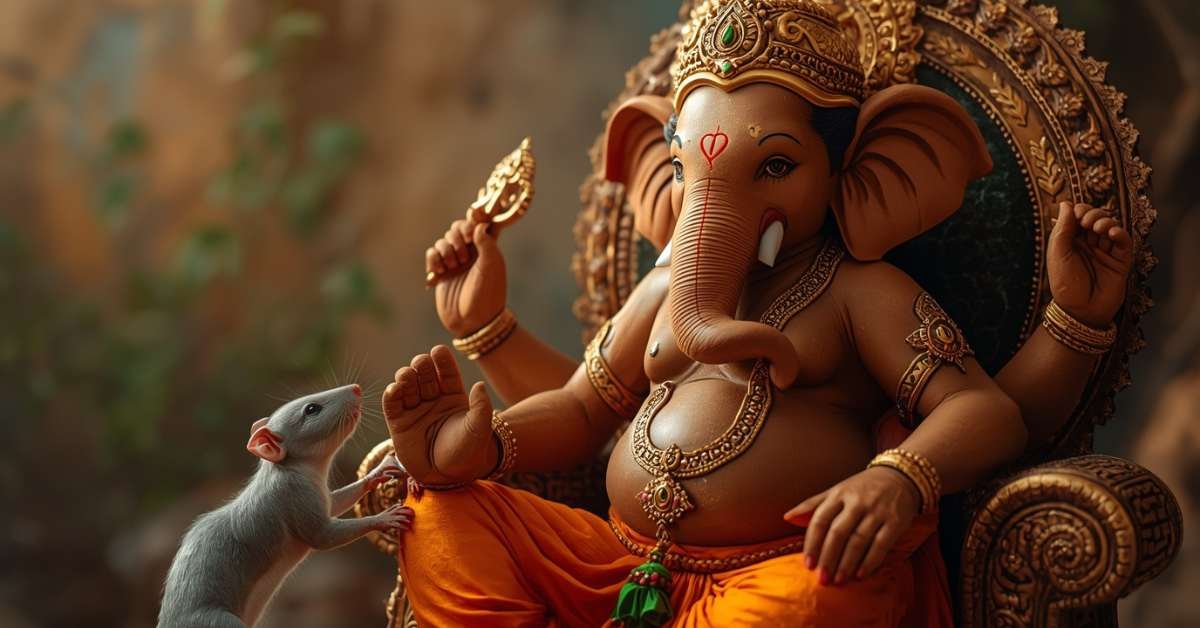
In most images, the rat sits at Ganesha’s feet, looking up at him. This position carries important symbolism:
- Desires should serve the higher self
- Ego bows before wisdom
- Lower nature supports higher purpose
- Strength comes from self-discipline
It shows the ideal relationship between human impulses and divine guidance.
A Powerful Symbol Packed into a Small Creature
The rat may seem like a simple or unlikely companion for a deity as grand as Ganesha, but its symbolism is profound. It represents desires, ego, intelligence, problem-solving, abundance, and transformation. It teaches that even the smallest and most overlooked aspects of ourselves hold great potential if we guide them with wisdom.
Ganesha riding the rat is a message that true mastery begins within. No matter how restless the mind or how strong the impulses, with awareness, discipline, and guidance, they can become allies rather than obstacles.
This ancient symbolism continues to inspire, teaching us humility, balance, adaptability, and self-awareness values needed as much today as in centuries past.