The ancient texts of Hatha Yoga, particularly the Hatha Yoga Pradipika, assert a fundamental truth. Before one can master the body (asana) or the breath (pranayama), the internal vessel must be clean. Just as you wouldn’t pour fresh milk into a dirty jar, you cannot fill a toxin-laden body with the high-voltage energy of Prana without risking imbalances.
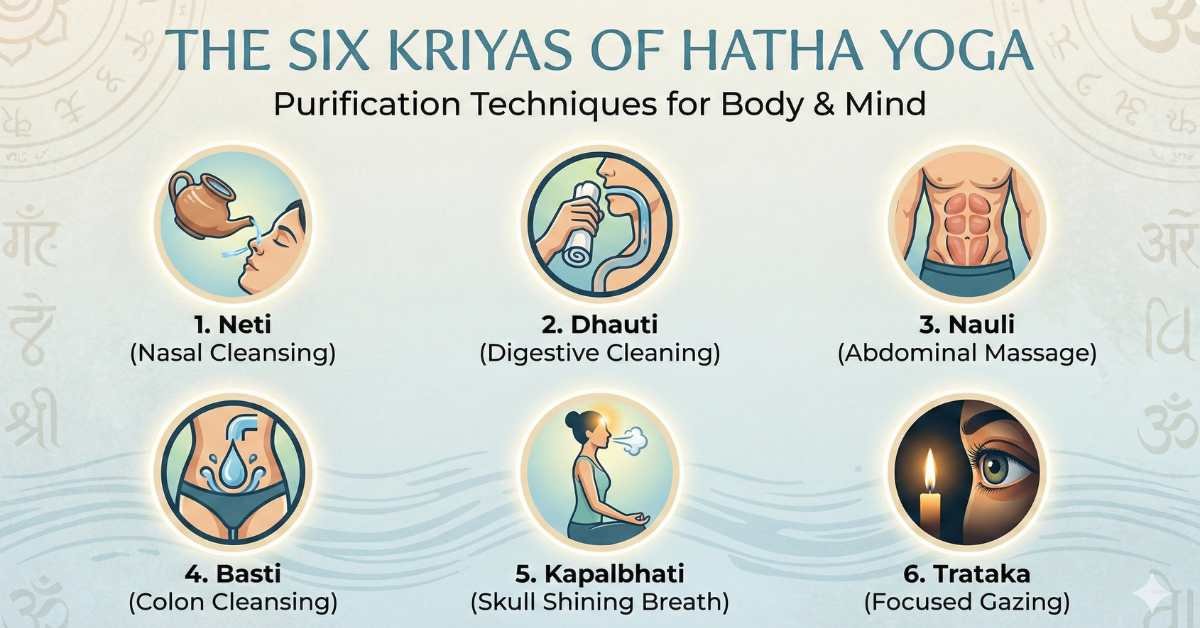
This process of deep internal purification is achieved through the Shatkriyas (Shat = Six, Kriya = Action). These six cleansing techniques are not merely hygiene rituals; they are powerful biological bio-hacks designed to remove excess mucus, bile, and wind (the three doshas of Ayurveda) from the body. By clearing these blockages, the Nadis (energy channels) open up, allowing Kundalini energy to flow freely.
Below is a comprehensive guide to the Six Kriyas, exploring the precise techniques and the profound physiological benefits of each.
1. Neti: The purification of the Nasal Passages
Neti is perhaps the most famous of the Kriyas in the West, often prescribed by ENT doctors for sinus relief. In Yoga, however, it is the key to Ajna Chakra (the third eye) and the gateway to effective Pranayama.
The Two Main Forms
- Jala Neti: Cleansing with saline water.
- Sutra Neti: Cleansing with a waxed cotton string or rubber catheter.
Technique: How to Perform Jala Neti
Preparation: You will need a specific “Neti Pot” (a small vessel with a long spout). Fill it with lukewarm water (roughly body temperature). Add half a teaspoon of non-iodised salt (rock salt or sea salt) per 500ml of water. The salinity should match human tears to prevent irritation.
The Process:
- Stance: Stand over a sink or in the garden. Lean forward slightly from the hips.
- Insertion: Tilt your head to the right side. Insert the spout of the pot gently into the left nostril (the upper nostril). Open your mouth and breathe only through the mouth.
- The Flow: Adjust the angle of your head until the water flows in through the left nostril and naturally pours out of the right nostril. Gravity does the work; do not sniff or force it.
- Completion: Let the pot empty halfway. Remove the spout, centre your head, and blow gently through both nostrils to clear excess water.
- Switch: Repeat on the other side (tilt head left, pour into right nostril).
- Drying (Crucial Step): After the water cleansing, you must dry the sinuses. Stand up, close one nostril, and exhale vigorously (like Kapalbhati) through the open nostril 10–15 times. Repeat on both sides. This prevents water from trapping in the sinus cavities, which can cause headaches or infection.
Health Benefits
- Respiratory Health: Removes mucus, pollen, dust, and allergens from the nasal tract, effectively treating sinusitis, allergies, and asthma.
- Sensory Acuity: Desensitises the sensitive inner lining of the nose, improving resistance to colds and coughs. It also improves the sense of smell.
- Mental Clarity: By cooling the frontal brain and removing obstructions to breathing, Neti has a soothing effect on the brain, reducing anxiety and anger.
2. Dhauti: Gastric Purification
Shutterstock
Explore
Technique: Vamana Dhauti (Kunjal Kriya)
Note: This practice should be done strictly on an empty stomach, first thing in the morning.
Preparation: Prepare 1.5 to 2 liters of lukewarm saline water (similar salinity to Neti).
The Process:
- Drinking: Squat or sit comfortably. Drink the water continuously and quickly, glass after glass. Do not sip; gulp it down. You must drink until you feel the stomach’s “hydrostatic pressure” is filled to the brim.
- The Release: Stand up and lean forward over a toilet or sink (90-degree angle).
- Triggering: Open your mouth wide. Insert your index and middle fingers toward the back of your throat (the root of the tongue). Gently massage or press to trigger the gag reflex.
- Expulsion: The stomach will contract and expel the water in a gush. Repeat the finger stimulation until the stomach is empty and no more water comes out.
- Rest: Wash your face and rest in Shavasana for 20 minutes. Avoid eating for at least 30 minutes after the practice.
Health Benefits
- Acidity and Bile: This is the ultimate remedy for hyperacidity, gastritis, and bile imbalance. It washes the stomach lining completely.
- Respiratory Relief: Surprisingly, Dhauti helps asthma and bronchitis. Removing excess mucus from the stomach, it reduces the overall mucus load in the chest region.
- Bad Breath: Eliminates the root cause of halitosis, which often stems from fermenting food particles in the stomach.
3. Nauli: Abdominal Churning and Isolation
Nauli is often considered the crown jewel of the Shatkriyas. It involves isolating the rectus abdominis muscles (the “six-pack” muscles) and churning them to massage the internal organs. It is an advanced practice that requires mastery of Uddiyana Bandha first.
Technique: The Stages of Nauli
Stage 1: Uddiyana Bandha (The Abdominal Lock). Stand with feet shoulder-width apart. Bend knees slightly and place hands on thighs. Exhale completely, emptying the lungs. Perform a “mock inhalation” (expanding the ribcage without letting air in). This creates a vacuum that sucks the diaphragm up and the abdomen in toward the spine. Hold as long as comfortable.
Stage 2: Madhyama Nauli (Central Isolation) While in Uddiyana Bandha, press your hands firmly into your thighs and push the central abdominal muscles forward while keeping the sides retracted. This creates a vertical ridge down the centre of the belly.
Stage 3: Vama and Dakshina Nauli (Left and Right)
- Vama (Left): Shift weight to the left arm and isolate the muscle on the left side.
- Dakshina (Right): Shift weight to the right arm and isolate the muscle on the right side.
Stage 4: Nauli Chalana (Churning) Once you can control the left, right, and centre isolations, you link them in a rolling motion. Roll the muscles from left to right, then right to left. This creates a wave-like churning motion in the belly.
Health Benefits
- Digestive Fire: It ignites Jatharagni (digestive fire), curing constipation, indigestion, and sluggish liver function.
- Deep Massage: It is the only exercise that manually massages the internal viscera—the liver, spleen, pancreas, and intestines—improving their function.
- Hormonal Balance: The pressure changes stimulate the endocrine system, helping to regulate diabetes and reproductive disorders.
4. Basti and Shankha Prakshalana: Colon Cleansing
While the prompt groups these, they are technically distinct. Basti is the specific Shatkriya referring to a yogic enema. Shankha Prakshalana is a complete alimentary canal cleanse (from mouth to anus).
Basti (Yogic Enema)
Traditionally, this was done by squatting in a river and using Nauli to create a vacuum to suck water up into the colon. Modern practitioners typically use an enema kit.
- Technique: Warm saline water or medicated oil is introduced into the rectum. The water is held for some time and then expelled.
- Benefit: Cleanses the lower colon (sigmoid and rectum) of old fecal matter and gas (Vata dosha).
Shankha Prakshalana (The Conch Shell Cleanse)
This is a more commonly practised “full detox” today.
Technique:
- Drink: You drink 2 glasses of warm saline water.
- Move: Immediately perform a set of 5 specific asanas (8 times each):
- Tadasana (Palm Tree Pose) – stretches the stomach.
- Tiryaka Tadasana (Swaying Palm Tree) – opens the pyloric valve.
- Kati Chakrasana (Waist Rotation) – massages the intestines.
- Tiryaka Bhujangasana (Twisting Cobra) – squeezes the cecum.
- Udarakarshanasana (Abdominal Massage Pose) – squeezes the colon.
- Repeat: Drink 2 more glasses, repeat the asanas.
- Evacuation: After several rounds, you will feel the urge to use the toilet. Eventually, the water coming out will be as clear as the water going in.
Health Benefits
- Total Reboot: It completely flushes the entire digestive tract (approx. 30 feet).
- Blood Purification: By cleaning the colon walls, nutrient absorption improves, and toxins stop leaching into the bloodstream.
- Skin Clarity: Chronic skin conditions like eczema and acne often clear up after this practice, as the skin reflects the state of the gut.
5. Kapalbhati: Skull Shining Breath
Getty Images
Explore
Technique: Active Exhale, Passive Inhale
Posture: Sit in a comfortable meditative pose (Padmasana or Sukhasana) with a straight spine. Hands in Chin Mudra (index and thumb touching) on the knees.
The Action:
- Inhale: Take a deep breath in to start.
- Exhale: Contract your abdominal muscles sharply and quickly to force the air out through the nose. Imagine you are trying to blow a fly off your upper lip. The belly snaps inward.
- Inhale: Relax the abdomen immediately. Do not inhale consciously. The recoil of the diaphragm will naturally pull air back into the lungs (passive inhalation).
- Rhythm: Establish a rhythm of about 1 breath per second. Do 3 rounds of 20–30 breaths to start.
Important: The chest should remain relatively still; the movement is entirely in the diaphragm and abdomen.
Health Benefits
- Sinus Cleansing: The force of the air clears the frontal sinuses and eliminates stale air from the lower lungs (residual volume).
- Oxygenation: It rapidly oxygenates the blood and removes carbon dioxide, energising the brain and removing mental fog.
- Nervous System Stimulant: It balances the sympathetic nervous system and is highly energising (do not do this right before bed).
6. Trataka: Focused Gazing
Trataka is the bridge between physical cleansing and meditation. It cleanses the eyes and the mind. It involves gazing steadily at an object without blinking.
Technique: Bahir (External) and Antar (Internal)
Preparation: Sit in a dark room. Place a candle at eye level, roughly an arm’s length away. Ensure there is no draft so the flame is steady.
Bahir Trataka (External Gazing):
- Gaze at the brightest part of the flame (just above the wick).
- Keep your eyes wide open. Do not blink.
- Push through the initial urge to blink. Your eyes may water (this is part of the cleansing).
- Continue until tears roll down or the eyes get tired.
Antar Trataka (Internal Gazing):
- Once the eyes are tired, close them gently.
- Visualise the after-image of the flame at the point between your eyebrows (Chidakasha).
- Focus on this internal point of light until it fades.
Health Benefits
- Ocular Health: Strengthens the eye muscles and cleanses the tear ducts. It corrects minor vision defects and relieves eye strain from screens.
- Concentration: It is the primary training for Ekagrata (one-pointed focus). It halts the restless movement of the eyeballs, which is directly linked to the restless movement of thoughts.
- Pineal Gland: The focus on light stimulates the pineal gland, helping to regulate the sleep-wake cycle and preparing the mind for higher states of meditation.
The Path to Higher Yoga
The Six Kriyas are potent tools. They are not intended to be daily practices for everyone forever (except perhaps Kapalbhati and Neti). They are therapeutic interventions used to restore balance when the body is sluggish or toxic.